
The Gut Microbiome in Autoimmunity
Your immune system's most fundamental job is to tell the difference between you and not you, and only attack the invaders. When it gets that wrong, the result is autoimmune disease: the body turning on its own tissues with the same ruthless precision it normally reserves for invaders. Rheumatoid arthritis. Multiple sclerosis. Lupus. Type 1 diabetes. These conditions affect hundreds of millions of people worldwide, and rates have been climbing for decades.
Genetics plays a role, but genes don't change fast enough to explain that rise. Something environmental is tipping the balance. As we explored in Why Gut Health Matters: The Science Behind the Microbiome, the trillions of bacteria living in your gut have a profound influence on your health, and increasingly, researchers are finding that influence extends to autoimmune disease in ways that are both surprising and specific. The gut, it turns out, may be one of the most important places to look when trying to understand why the immune system loses its way.
The Immune System's Home Base
Roughly 70% of your immune tissue surrounds the gastrointestinal tract. That's not a coincidence. It's because the gut is where the immune system faces its biggest daily challenge: learning to coexist peacefully with trillions of microbes while still identifying and defending against genuine threats. It's a delicate balance and it requires constant calibration.
This relationship goes both ways. Gut bacteria don't just sit there being tolerated. From the earliest days of life, they help train the immune system, teaching it what's safe, what isn't, and how forcefully to respond. They influence which immune cells get made, how aggressively those cells behave, and whether inflammation resolves cleanly or lingers and builds. A diverse, balanced microbiome tends to produce a well-regulated immune system. A disrupted one, marked by the loss of key species or the overgrowth of others, can leave the immune system poorly calibrated and prone to misfiring. And in people with a genetic predisposition to autoimmunity, that misfiring can have serious consequences.
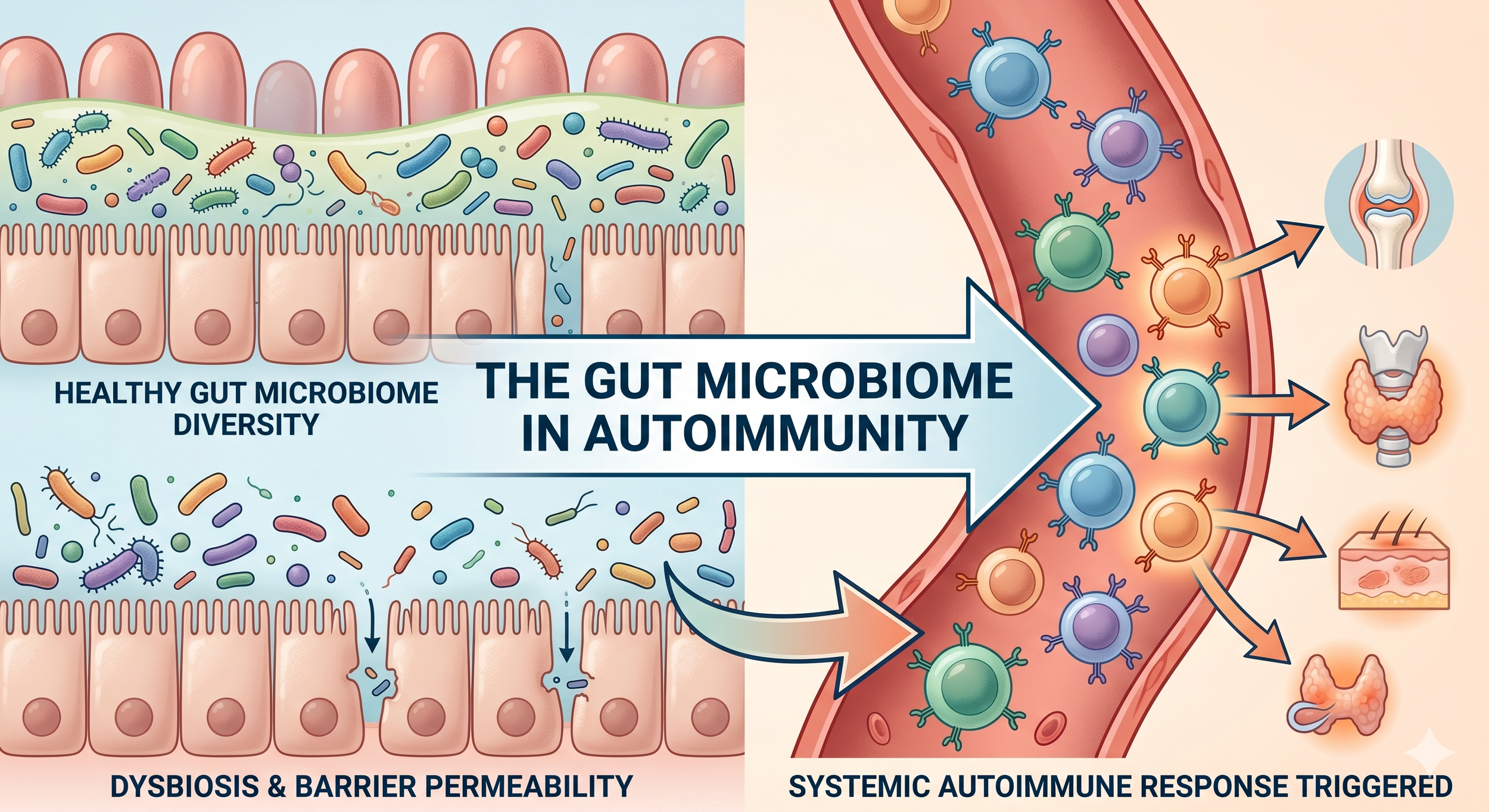
A side-by-side comparison showing a healthy gut microbiome versus dysbiosis, and how a compromised gut barrier allows immune cells to trigger autoimmunity.
Rheumatoid Arthritis
One of the clearest examples of a specific microbe influencing a specific disease involves a bacterium called Prevotella copri and rheumatoid arthritis. In a landmark study, researchers found P. copri in about 75% of newly diagnosed RA patients, compared to just 21% of healthy controls (Scher et al., 2013). What made this finding particularly striking was the timing. The bacterium was showing up before significant joint damage had occurred. This wasn't a consequence of disease. It was there at the very beginning, raising the possibility that it was helping to set things in motion.
Animal studies sharpened the picture considerably. When mice were colonized with P. copri-rich microbiota from RA patients, they developed more severe arthritis and showed elevated levels of Th17 immune cells in the intestine, potent drivers of inflammation (Chen et al., 2025). In some models, colonization with P. copri alone was enough to trigger joint inflammation when paired with a mild immune challenge, something that didn't happen in its absence (Maeda & Takeda, 2019). The bacterium appears to prime the immune system for an inflammatory response, particularly in those who are already genetically susceptible.
The twist? A closely related species, Prevotella histicola, appears to do the opposite, actively suppressing arthritis development in animal models (Maeda & Takeda, 2019). Two bacteria from the same genus, with near-opposite effects on the same disease. It's a reminder that in the microbiome, the details matter enormously, and that broad characterizations of bacteria as simply "good" or "bad" rarely hold up under scrutiny.
Lupus
In systemic lupus erythematosus, a more unsettling story is emerging. A bacterium called Enterococcus gallinarum, normally confined to the intestine, has been found to escape the gut in some lupus patients, migrating to the liver, spleen, and lymph nodes when the intestinal barrier breaks down (Manfredo Vieira et al., 2018). Once it reaches those tissues, it activates Th17 immune cells and stimulates the production of autoantibodies, proteins that mistakenly target the body's own cells. This is one of the hallmarks of lupus, and the idea that a wandering gut bacterium might be helping to drive it is both remarkable and sobering. When researchers blocked this migration in mice, autoimmune activity decreased, suggesting that keeping bacteria where they belong may be as important as which bacteria are present in the first place.
Separately, a bacterium called Ruminococcus gnavus has been found in elevated levels in lupus patients with kidney involvement, a serious complication called lupus nephritis, and its abundance appears to track closely with how active the disease is at any given time (Wang et al., 2024). Researchers are still working to understand the mechanism, but the consistency of the association across studies has made R. gnavus one of the more closely watched microbes in lupus research.
Multiple Sclerosis
MS offers perhaps the most complicated microbiome story yet, centered on a bacterium called Akkermansia muciniphila. It's consistently found at higher levels in MS patients than in healthy individuals, a finding replicated across multiple independent cohorts (Schumacher et al., 2025). On the surface, that sounds like bad news. But the picture gets more complicated when you look at disease progression: as MS advances and disability worsens, A. muciniphila levels actually tend to fall, suggesting it may play a protective role in later stages of the disease (Tran et al., 2024). The same bacterium that appears elevated at disease onset seems to diminish as things get worse.
A 2025 study published in PNAS added yet another layer. Rather than looking at A. muciniphila in isolation, researchers examined its ratio to another bacterium, Bifidobacterium adolescentis. A lower ratio of B. adolescentis to A. muciniphila correlated with higher disability scores, and introducing MS-associated Blautia bacteria into mice shifted that ratio downward and triggered MS-like inflammation (Silverstein et al., 2025). The finding suggests that microbial relationships, not just individual specie, may be what matters most.
Further research has shown that A. muciniphila appears to behave very differently depending on the broader microbial environment surrounding it. In a gut rich in Clostridia, bacteria that produce anti-inflammatory short-chain fatty acids, its presence worsened disease in animal models. In a Clostridia poor environment, it didn't have the same effect (Fournier et al., 2025). It's not simply good or bad. It's context-dependent in ways that make simple interventions, just add more of this, less of that, unlikely to work without a much deeper understanding of the whole ecosystem.
A Field in Motion
Across rheumatoid arthritis, lupus, and multiple sclerosis, a consistent pattern is emerging: specific gut microbes aren't passive bystanders to autoimmune disease. They appear to be active participants, activating inflammatory immune cells, weakening the gut barrier, altering the production of key metabolites, and in some cases physically escaping into tissues where they trigger responses the body struggles to turn off.
The science is still evolving, and it's worth noting that much of the strongest mechanistic evidence comes from animal models. Establishing causation in humans is harder, slower work. Microbiome research is also notoriously difficult to standardize. Findings can vary across populations, geographies, and study designs. But the convergence of evidence across multiple diseases and multiple research groups is hard to ignore. If certain microbes are genuinely contributing to certain diseases, the microbiome becomes not just a diagnostic signal, but a therapeutic target. And that changes the conversation considerably.
The Question Worth Sitting With
We've long described autoimmune disease as the immune system turning against the self, a story of internal malfunction, of the body becoming its own enemy. But what if, in some cases, it's more accurately described as the immune system responding to microbial signals it was never supposed to receive? What if bacteria that have escaped their boundaries, or colonized in the wrong proportions, are issuing instructions the immune system is simply following?
That reframing doesn't make these diseases any less serious. But it may change fundamentally where we look for answers and what kinds of interventions we imagine are possible.
References
Chen et al. (2025). Clinical and Experimental Medicine. doi:10.1007/s10238-025-01777-x
Fournier et al. (2025). Frontiers in Immunology. doi:10.3389/fimmu.2025.1655428
Maeda & Takeda (2019). Experimental & Molecular Medicine, 51, 1–11.
Manfredo Vieira et al. (2018). Science, 359(6380), 1156–1161.
Scher et al. (2013). eLife, 2, e01202.
Schumacher et al. (2025). The FEBS Journal. doi:10.1111/febs.17161
Silverstein et al. (2025). PNAS, 122(9), e2413953122.
Tran et al. (2024). Scientific Reports, 14, 15123.
Wang et al. (2024). Autoimmunity Reviews, 23(12), 103654.
